The Arm That Changed the UniMAC - IJ Student Purse: Funds Diverted, Students' Silenced

“Is my urgent surgery and the ability to use my arm again not more important, even for a moment, than a programme that can be rescheduled?”
The question came from the interim SRC President, Bernard Afful (alias Kofi Nyamekye), as he defended his decision to divert thousands of student funds for what he described as an urgent medical emergency.
Across the UniMAC–Institute of Journalism (IJ) campus, however, the response was not debate but restraint.
Phones are checked twice before messages are sent.
Social media posts are measured.
Weeks before the diversion became public, the Dean of Students, Dr. Tandoh, warned that taking matters to the media could cost academic records, reputations, and even future careers.
The message landed like a shadow over every conversation, leaving vigilance muted and accountability stalled.
For many, the choice was simple, stay silent, or risk everything.
The story is now as much about the missing money as it is about the climate of caution that some say has replaced accountability.
GHS7,500 Redirected: What the Money Was Originally Meant For
Public confidence in student leadership was already fragile.
The previous SRC administration had exited office amid allegations of mismanagement, leaving behind GHS14,832.52 in SRC funds. By the time the interim administration assumed office, the account balance had since declined.
In the second semester of the 2024/2025 academic year, ahead of SRC Week, the council’s most expensive activity, the interim SRC President reviewed the proposed budget and reduced the Organising Secretary’s allocation by GHS3,000. Financial records show that a total of GHS41,900 was eventually spent on the SRC Week activities.
At the point when the budget adjustment was made, the SRC account balance stood at GHS7,279.17 in the second semester, roughly half of what the interim administration inherited.
According to interim SRC executives, the GHS3,000 was handed to the President to be deposited back into the SRC account because the Financial Secretary was unavailable. The President, a signatory to the account, was expected to complete the deposit, a move that would have raised the balance to GHS10,279.17, in line with assurances that not less than GHS10,000 would be left for the next administration.
Separate from this was a GHS4,500 allocation to the Office of the President, earmarked for a student-focused programme dubbed “Vibes and Velvet”, designed to address youth development, relationship dynamics, and sexual health.
Weeks before the GHS7,500 controversy emerged, the interim SRC President had already acknowledged a lapse in official responsibility.
On 11 July 2025, he issued a public apology to PR students and heads of department after failing to communicate the postponement of a scheduled Meet and Greet programme slated for 11-12 July, despite being aware of the decision. In that communiqué, he cited a fracture to his left arm following an accident as context for the lapse.
Barely two weeks later, between 25 and 27 July, the SRC embarked on SRC Week, drawing heavily on already constrained reserves.
It was within this period of heightened responsibility and shrinking funds that the redirection of GHS7,500 would later emerge.
Together, these two sums, GHS3,000 from the SRC Week budget and GHS4,500 from the President’s allocation, formed the GHS7,500 later redirected by the President for his alleged surgery.
The reallocation immediately drew questions from vigilant students and soon prompted clarification from the President and the executives.
In a formal communique dated 9 September 2025, the President explained that an unforeseen medical emergency, a fractured arm requiring urgent surgery, had necessitated the redirection of funds. He phrased the decision as one guided by necessity, arguing that safeguarding his health was essential to continuing his service to students.
The communiqué stressed that the funds were not used for personal enrichment, that executives were informed, and that medical records and receipts would be made available for audit. He pledged a post-surgery report and appealed for patience and understanding.
But multiple SRC executives later told Unheard that they were not aware the funds had actually been diverted for medical use at the time the decision was taken.
Growing student dissatisfaction and subdued agitation on campus eventually prompted an intervention by the Office of the Dean of Students.
On 17 September 2025, a meeting was convened between university management and SRC leadership. According to a summary circulated to students, Bernard Afful admitted that he had acted irresponsibly in handling the GHS7,500 and accepted full responsibility.
SRC executives, speaking in the presence of the Dean, condemned the action, warning that it undermined the credibility and integrity of the Students’ Representative Council.
The meeting resolved that the entire GHS7,500 would be refunded within three months, either in instalments beginning November 2025 or in full by January 2026. Afful was required to sign a formal commitment binding him to the repayment terms.
Had the repayment been completed as agreed, the SRC account would have been restored to roughly the same level it stood at before the interim committee assumed office.
As of publication, however, only GHS2,000 had been repaid, leaving the account balance still below the amount inherited from the previous administration.
While the agreement outlined a repayment timeline, its partial fulfilment has prompted broader questions among students about the effectiveness of the University’s internal accountability processes.
One student, speaking to Unheard on condition of anonymity, questioned the pace and credibility of such mechanisms:
“How long does it take for management to solve an issue without external pressure?” the student asked. “When we’re told to rely on internal structures, what exactly are those structures, and what solutions have they produced?”
The document further states that failure to honour the agreement would attract disciplinary sanctions, including the withdrawal of Afful’s academic certificate.
Despite this intervention, critical questions remain unanswered.
Multiple sources who attended the meeting told Unheard that no medical invoices, hospital reports, or receipts were presented to substantiate the alleged surgery. The discussion, they said, focused primarily on addressing student concerns and arranging the repayment of the funds, rather than independently verifying the expenditure.
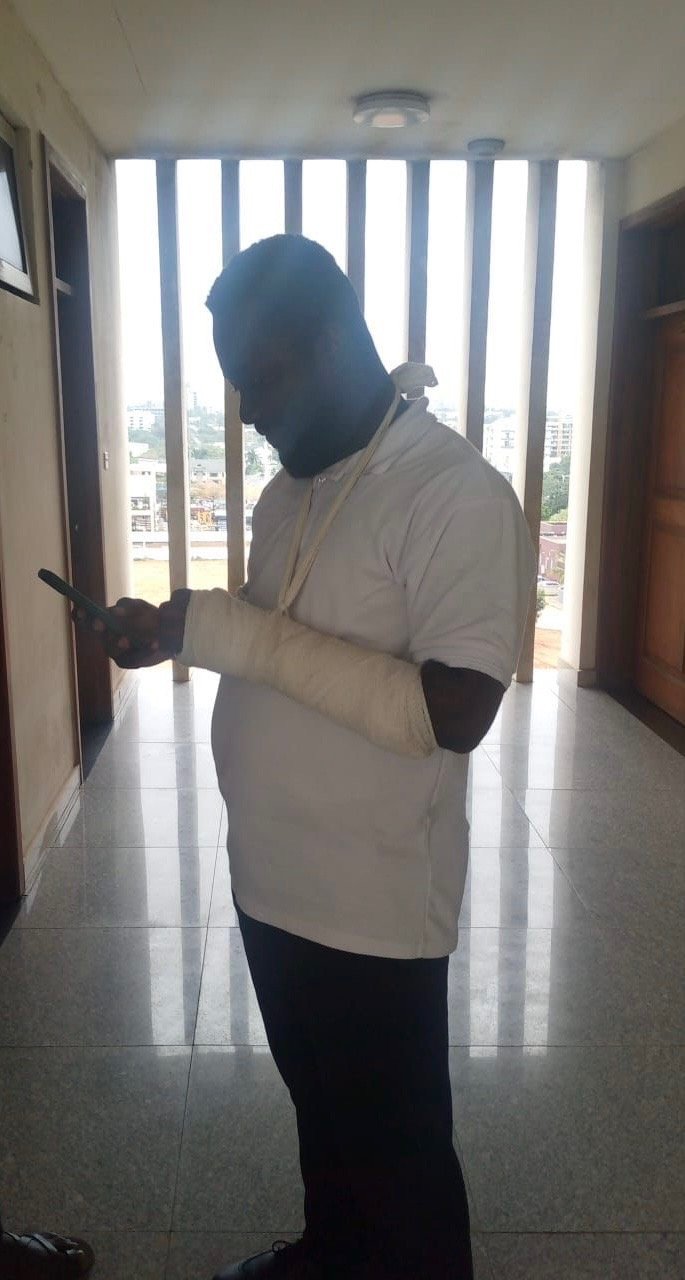
For many students, the arm sling worn by the President became the only visible indication that a medical procedure may have occurred, leaving accountability resting largely on a visible arm sling, rather than independent documentation.
“SRC Funds Were the Fastest and Least Disruptive Option” - Bernard Afful
To understand the situation, Unheard reached out to the SRC Interim President, Kofi Nyamekye. After three months of repeated calls, messages, and follow-ups, he responded to Unheard in January 2026, following a final message emphasising his right of reply before publication.
When asked whether there were alternative ways to pay for the surgery, Afful revealed that, “In theory, yes. In practice, the situation required urgent action. The SRC funds were the fastest and least disruptive option available at the time,” he said, emphasizing that the decision was made with the understanding that every cedi would be properly accounted for.
He said the GHS7,500 covered only part of the medical costs, with the remainder paid from personal sources.
Afful maintained that his incapacitation would have disrupted SRC operations and student representation, arguing that safeguarding his health was inseparable from safeguarding institutional stability.
Addressing concerns about precedent, he described the decision as exceptional, insisting it did not amount to blanket approval for personal use of SRC funds. The programme affected, he said, was non-emergency and reschedulable, and was deferred rather than cancelled.
Unheard sought further clarification on which alternatives were considered, why they were deemed unworkable, who authorised the use of SRC funds on the basis of urgency, and what Afful meant by “least disruptive”, whether it applied to SRC programmes, his office, or the student body. These questions went unanswered.
Unheard further requested copies of medical invoices, hospital reports, and receipts referenced in his communique. He said documentation exists but should be shared only through “appropriate institutional channels,” cautioning that the absence of public disclosure should not be interpreted as absence of records.
As of publication, neither Unheard nor SRC executives have independently verified the existence or contents of these records.
Life of An SRC Without A General Assembly
The claim of urgency raises deeper constitutional concerns.
The General Assembly, the students’ watchdog and safeguard, was nowhere to be seen in this administration.
Students felt invisible. “It’s like our voices don’t matter,” one class representative said quietly. “We’re trained to question, to hold leaders accountable, but when the system fails us, what do we do?”
The General Assembly (GA) is constitutionally mandated as the primary oversight body of the SRC, responsible for scrutinising financial decisions, questioning executive actions, and ensuring that student funds are used transparently and in the collective interest of the student body.
Under Articles 12 and 13 of the GIJ SRC Constitution, legislative and financial oversight powers are vested in the GA, which comprises class representatives, hall presidents, club and society leaders, and SRC legislative officers. The Constitution requires the GA to debate and approve executive programmes, examine financial statements, and exercise sanctions where financial transactions occur without prior approval.
The interim committee, when it was constituted, was required to operate within these same constitutional limits under Article 7, which defines the scope of executive authority and emphasises consultation and accountability, particularly in financial matters.
By failing to convene the GA, the interim committee bypassed this oversight mechanism, leaving the GHS7,500 expenditure solely at the discretion of the SRC President and his executive team. In effect, there was no formal approval, no institutional verification, and no independent scrutiny of the claimed urgency behind the reallocation.
While students have raised serious concerns about the reallocation of GHS7,500, many have remained largely silent, restrained by an earlier warning from the Dean of Students. According to the directive, taking issues to the media without first exhausting internal channels could result in unintended consequences, including potential damage to academic records, future career prospects, and personal reputations. The cautionary note has created a climate in which scrutiny is stifled, and questions about accountability linger without being openly addressed.
Despite this, some students spoke to Unheard on condition of anonymity. One described the redirection as a “discreet scheme by a leader who appears to go on a spending spree of student funds for personal activities without recourse to law.”
Another said the expenditure, made without prior consultation or approval, amounted to corruption, arguing that the ₵7,500 was not intended to serve as an emergency fund for the SRC President and should have been safeguarded for collective student use.
A third remarked, “I have always heard about corrupt practices in the SRC, but I did not expect to witness one firsthand. Incidents like this confirm that those entrusted with student funds must be held accountable; otherwise, the system risks becoming a training ground for future mismanagement.”
Before the Funds Vanished: How a Dean’s Warning Muffled Student Scrutiny
Before the GHS7,500 brouhaha came to light, the Office of the Dean of Students had already issued a communique on 18 August 2025, cautioning students against taking internal matters to the media without exhausting institutional channels. The directive warned that failure to adhere could lead to “unintended consequences, including damage to academic records, future career prospects, and personal reputations.”
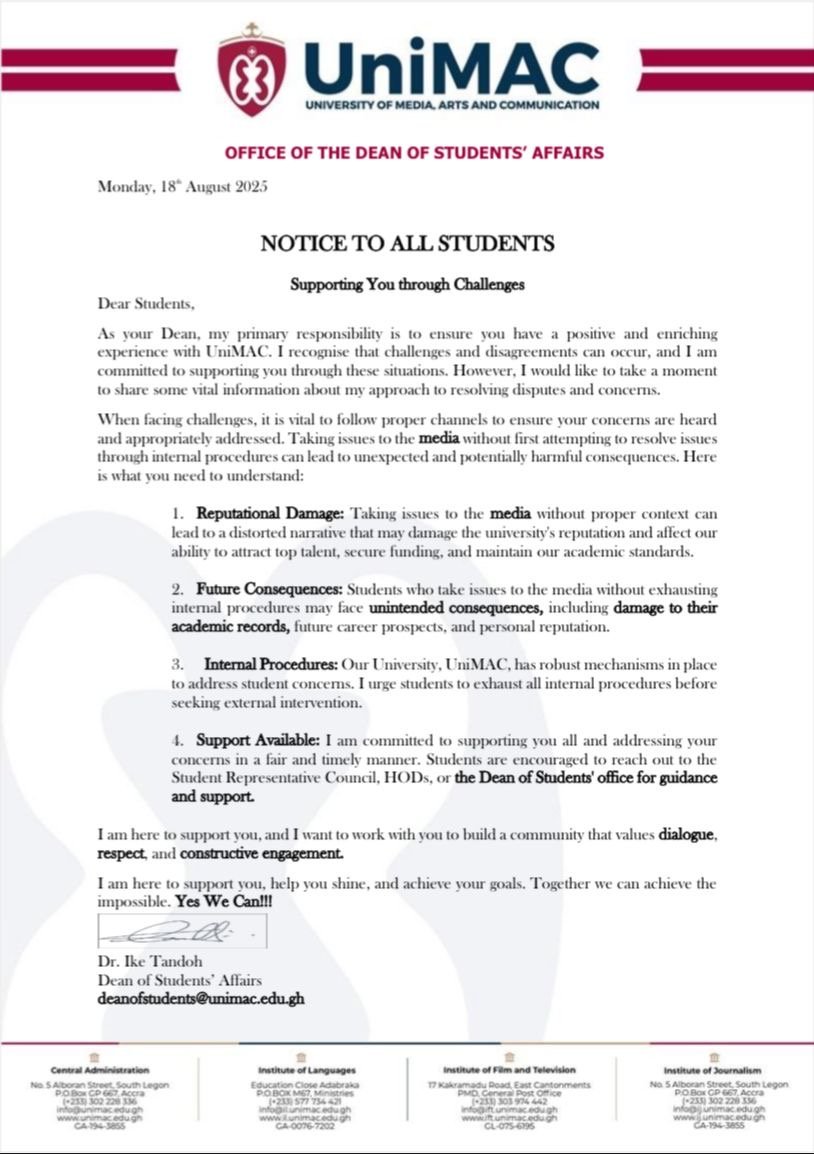
In an effort to contextualise the impact of this directive, Unheard reached out to the Dean for clarification. The request sought insight not only on the SRC fund management concerns but also on the background, purpose, and implications of the early communiqué. The Dean responded, noting that, as the new DoS, he did not have the authority to speak on behalf of the University for stories published externally and advised directing queries to the Public Affairs Director. In a follow-up clarification, Unheard emphasised that the inquiry was not intended to represent the University, but to understand the intent and application of the communiqué itself. As of the time of publication, no substantive response has been received.
The warning, probably intended as guidance, instead created a climate of apprehension among students. Several students told Unheard that it has made them reluctant to speak out or ask questions about SRC fund management.
One student explained, “Already most people appear to be conservatives and therefore do not express their views on issues like these, and to have a Dean issue a directive like such exacerbates the realities of student life in the university community.” Another added, “This is a journalism school, so if we cannot keep our leaders accountable, does it mean that the lessons we are given in school are only for us to ‘chew and pour’ to pass our exams?”
Several students expressed concerns that the directive inadvertently shields internal politicking from scrutiny. Another described the directive as “disheartening and appalling,” arguing that it undermines free speech and investigative scrutiny, core principles in a journalism school. Others noted that many students have withdrawn entirely from expressing their views, uncertain of the consequences for their academic records, careers, or reputations.
Against this backdrop of caution, the interim SRC President had begun repaying the GHS7,500. By the time of publication, he had returned GHS2,000, according to a communique from SRC executives and confirmations from SRC sources, including Bernard Afful. Yet, despite the partial repayment, questions linger.
Students still do not have access to hospital invoices, receipts, or any documentation to verify the alleged surgery, leaving accountability unfulfilled and mistrust pervasive.
The combination of the Dean’s directive, the absence of independent verification, and selective transparency from the SRC has left many students feeling silenced and skeptical.
As one student bluntly put it,“Students do not know how they are going to be punished for speaking out, so everyone has withdrawn into their own shell.”
Certificate Withholding Announced and Enforced?
On 24 November 2025, four days before the 2024/2025 Undergraduate graduation ceremony, a communiqué issued by the Office of the Coordinating Committee stated that the University had decided to withhold the academic certificate of SRC President Bernard Afful until the outstanding GHS7,500 was fully repaid.
Graduation day proceeded as scheduled. Afful took part fully in the ceremony and had his name called among the first-class graduates.
In an interview with Unheard, he said that despite public claims that his certificate was to be withheld, he was not formally served with any written notification indicating a restriction on his academic certificate, nor did he receive any official letter or notice outlining such measures at the time of graduation.
In light of the public statements and Afful’s statement that he received no written notification, Unheard submitted a Right to Information (RTI) request seeking official institutional records related to the matter. The request asks for copies of any correspondence or memoranda authorising the withholding of Afful’s academic results or certificates; the updated graduation list reflecting any changes to the status of the SRC President; and any formal agreement or written commitment detailing the repayment terms for the GHS7,500. Under Ghana’s Right to Information Act (989), the institution is required to give a response within 14 working days.
Any response received will be incorporated into this report or published as an update.